ANNUAL SPECIAL ISSUE
Special Annual Issue on Macroeconomics and Development
Volume 35, Issue 2 — April 2026
Guest Editors: Giovanni Dosi and Joseph E. Stiglitz
Read the Special Issue →
Latest
Volume 35
Issue 3
June 2026
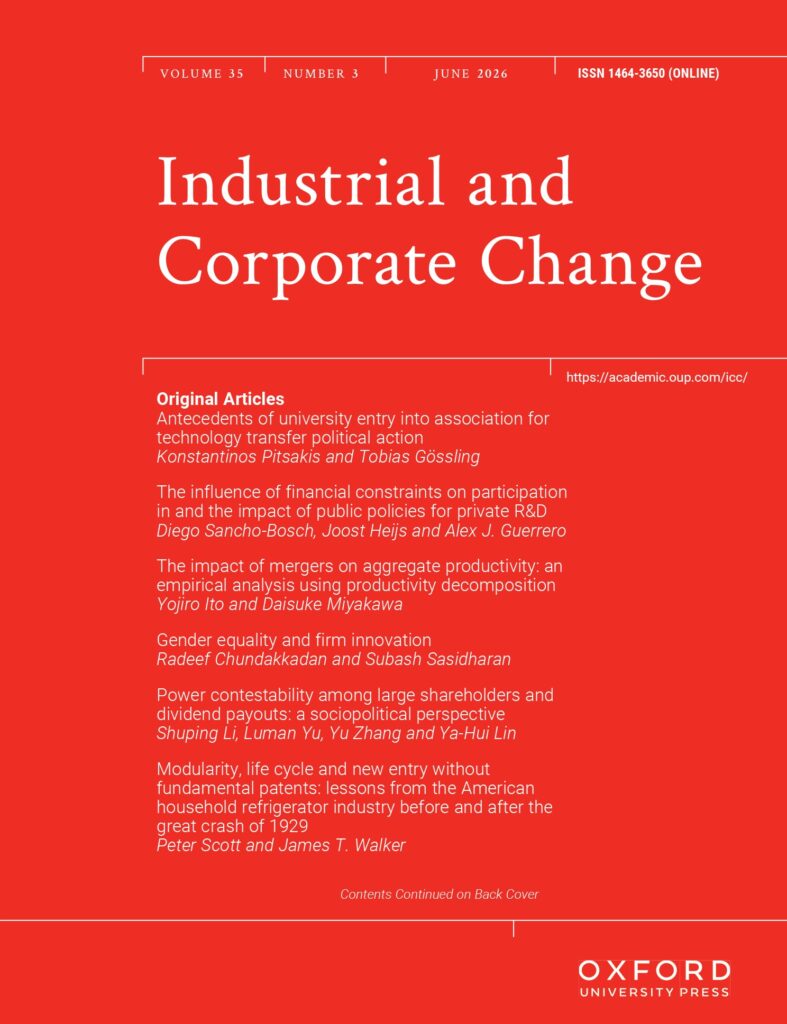
Editor’s Choice
From Bounded Rationality to Ecological Rationality
Industrial and Corporate Change
Volume 35
Issue 3
June 2026
https://doi.org/10.1093/icc/dtag017
Gerd Gigerenzer
Abstract
Herbert Simon’s bounded rationality offers three principles for building a theory of behavior: (i) to study the process of actual decision making (as opposed to as-if models of expected utility maximization), (ii) to study how decisions are made in situations of uncertainty and intractability (as opposed to risk and ambiguity alone), and (iii) to study how minds adapt to environments (as opposed to modeling solely the mind or the environment). Economists hijacked bounded rationality by reinterpreting it to mean optimization under constraints, and psychologists by reinterpreting it as the study of cognitive biases, that is, deviations from optimization. This contradictory double-takeover silenced the revolutionary essence of Simon’s program. My colleagues and I have revived and extended Simon’s lost program, choosing the term ecological rationality to avoid any confusion. As opposed to the cognitive biases program, the study of ecological rationality is both descriptive and prescriptive. It investigates the repertoire of heuristics individuals or institutions have at their disposal (their adaptive toolbox) as well as the conditions under which each heuristic is successful and thus should be used, as measured by real-world criteria (the ecological rationality of heuristics). The study of the adaptive toolbox relies on observation and experimentation; the study of the conditions under which various heuristics should be used relies on mathematical analyses and computer simulations. This combination of descriptive and prescriptive analysis offers a novel perspective for behavioral economics and the study of decision-making in general.
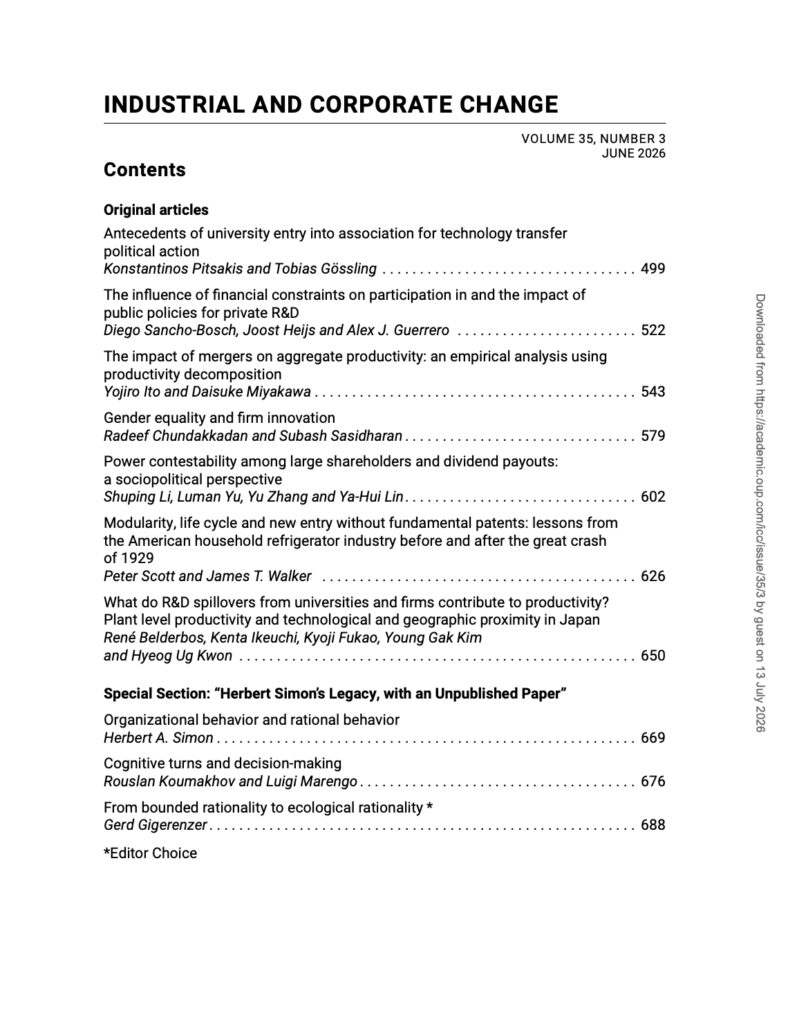
Original articles
Antecedents of University Entry into Association for Technology Transfer Political Action
Konstantinos Pitsakis and Tobias Gössling
The Influence of Financial Constraint on Participation in and the Impact of Public Policies for Private R&D
Diego Sancho-Bosch, Joost Iteijs and Alex J Guerrero
The Impact of Mergers on Aggregate Productivity: An Empirical Analysis using Productivity Decomposition
Yojiro Ito and Daisuke Miyakawa
Gender Equity and Firm Innovation
Radeef Chundakkadan and Subash Sasidharan
Power contestability among large shareholders and dividend payouts: a sociopolitical perspective
Shuping Li, Luman Yu, Yu Zhang and Ya-Hui Lin
Modularity, life cycle and new entry without fundamental patents: lessons from the American household refrigerator industry before and after the great crash of 1929
Peter Scott and James T Walker
What do R&D spillovers from universities and firms contribute to productivity? Plant level productivity and technological and geographic proximity in Japan
René Belderbos, Kenta Ikeuchi, Kyoji Fukao, Young Gak Kim and Hyeog Ug Kwon
SPECIAL SECTION: HERBERT SIMON’S LEGACY, WITH AN UNPUBLISHED PAPER
Organizational behavior and rational behavior
Herbert A Simon
Cognitive turns and decision-making
Rouslan Koumakhov and Luigi Marengo
From bounded rationality to ecological rationality*
Gerd Gigerenzer
*Editor’s Choice